
Table of Content
- Understanding SMILE and LASIK: A Brief Overview
- LASIK and Dry Eye: What You Should Know
- SMILE and Dry Eyes: What You Should Know?
- Clinical Studies: SMILE vs LASIK for Dry Eye
- Why Dry Eye Happens After Vision Correction Surgery?
- Expert Tips for Managing Dry Eye Post-Surgery
Vision correction surgeries like SMILE (Small Incision Lenticule Extraction) and LASIK (Laser-Assisted In Situ Keratomileusis) have truly transformed modern eye care, making it possible for millions to enjoy clear vision without glasses or contact lenses. These procedures are now much safer and more convenient than ever before. However, it’s important to understand that one common postoperative issue is dry eye, which can affect comfort and recovery after surgery. This blog will help you better understand the risk of SMILE vs LASIK dry eyes by presenting facts, patient experiences, and clinical research.
Understanding SMILE and LASIK: A Brief Overview
SMILE and LASIK are two of the most effective refractive or commonly known as laser vision correction surgeries that use advanced lasers to correct refractive errors like myopia (nearsightedness), hyperopia (farsightedness), and astigmatism. However, they are distinct from each other in several aspects:
| Feature | SMILE | LASIK |
| Year Introduced | 2008 | 1990 |
| FDA Approval | 2016 | 1999 |
| Method | Small corneal incision | Creation of a corneal flap |
| Tissue removal | Lenticule (tiny disc) extracted | Cornea reshaped under a flap |
| Incision size | Approximately 2–3 mm | 20 mm (larger due to flap creation) |
| Preservation of cornea | More of cornea left untouched | Flap can impact corneal nerves |
| Flap creation | No | Yes |
| Laser used | Femtosecond laser | Excimer laser |
| Corrects | Myopia and astigmatism | Myopia, hyperopia, astigmatism |
| Recovery Time | Rapid (within days) | May take longer than SMILE |
SMILE surgery is considered less invasive and preserves more of the cornea’s natural strength, while LASIK involves lifting a flap, which may increase certain risks.
Expert eye surgeons at Planet Lasik suggest pre-surgical screening tests like Schirmer’s test or tear breakup time to evaluate dryness risk.
LASIK and Dry Eye: What You Should Know
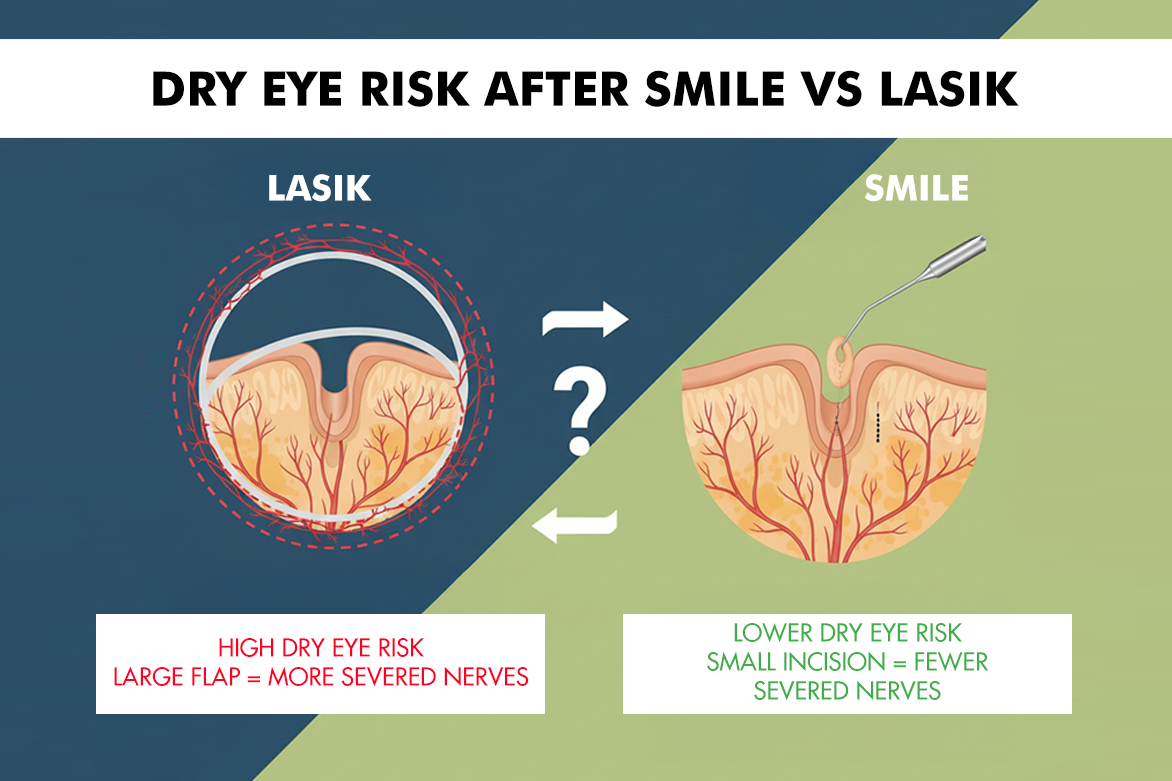
Like we read before that LASIK surgery involves the creation of a corneal flap, which raises the chance of dry eyes after LASIK surgery very prominently. Here are some critical facts:
- Studies show that up to 60% of LASIK patients may develop some dry eye symptoms immediately after surgery.
- The process of creating a corneal flap can cut nerves that control natural tear production.
- Symptoms can include dryness, grittiness, redness, blurred vision, and light sensitivity.
- For many patients, these symptoms improve over weeks to months with proper eye care.
- Factors like long screen time, air-conditioned environments, and certain medications can increase dry eyes after LASIK.
In summary, LASIK is very effective, but patients should be aware of dry eye as a possible short-term or sometimes even longer-term effect.
SMILE and Dry Eyes: What You Should Know?
SMILE is often called a gentler alternative. Here’s why:
- The smaller incision means fewer corneal nerves are disturbed during the procedure, which potentially lowers the chance of dry eyes after SMILE surgery.
- The laser used, which is the 1st generation femtosecond laser, fires the laser shots precisely, causing less corneal nerve damage.
- Most studies suggest SMILE patients tend to have reduced dry eye severity and faster recovery.
- A 2022 study published in the Journal of Cataract & Refractive Surgery found that dry eye symptoms were significantly less severe and resolved more quickly after SMILE than after LASIK.
- However, it’s important to note that while the risk is lower, dry eye still can happen after SMILE, just less frequently or less intensely.
Clinical Studies: SMILE vs LASIK for Dry Eye
Data from clinical research done on a few patients would help you compare these two surgeries:
| Study Year | Number of Patients | Key Finding |
| 2021 | 120 | Dry eye symptoms were milder and resolved within 1 month for most SMILE patients |
| 2022 | 200 | LASIK patients reported longer-lasting dryness, some up to 6 months after surgery |
| 2023 | 150 | Tear film function and corneal nerve density restored faster after SMILE than after LASIK |
*Tip from a LASIK patient: “Avoid air-conditioned rooms and always follow your post-op care instructions, especially early on.”
Watch here a successful SMILE surgery experience at Planet Lasik
LASIK Eye Surgery Success Story | Centre for Sight Surat | Dr. Paresh M Vaidya
*Tip from a SMILE recipient: “Stay hydrated and use eye drops even if your eyes don’t feel dry initially.”
Watch here a successful SMILE surgery experience at Planet Lasik
USA Patient’s Painless SMILE Eye Surgery at Centre For Sight Vadodara | Dr. Rupal Shah Review
However, individual results may vary, but these clinically verified insights can help set realistic expectations for anyone considering laser vision correction.
Why Dry Eye Happens After Vision Correction Surgery?
Dry eye syndrome occurs when your eyes can’t produce enough tears or your tears evaporate too quickly, leading to discomfort, blurry vision, and irritation. Both LASIK and SMILE can disrupt the nerves that signal tear production.
Who Is at Higher Risk for Postoperative Dry Eye?
Certain factors can increase the likelihood and severity of dry eye after ASIK or SMILE surgery:
- Age over 40 – Age-related changes in tear production can make older individuals more susceptible to dry eye after SMILE or LASIK surgery.
- Female gender (especially postmenopausal) – Hormonal fluctuations, particularly during menopause, can affect tear production and contribute to dryness.
- Autoimmune conditions (like Sjögren’s syndrome)
- History of severe allergies
- Long-term contact lens wear – Prolonged contact lens use can sometimes be associated with pre-existing dry eye conditions that may be worsened by LASIK.
- Environmental exposures (air conditioning, pollution)
Expert Tips for Managing Dry Eye Post-Surgery
To reduce dry eye risk and speed recovery after LASIK or SMILE eye surgery, experts recommend:
Before Surgery
- Discuss your dry eye history honestly with your eye surgeon.
- Have a comprehensive pre-op evaluation to catch risks early.
After Surgery
- Artificial tears: Use preservative-free drops as directed.
- Wear sunglasses: Shield from the sun and wind
- Avoid exposure: Stay clear of dusty, windy, or dry environments.
- Screen breaks: Reduce eye strain by taking regular breaks from digital devices.
- Stay hydrated: Drink plenty of water daily.
- Omega-3 supplements: Some studies suggest these may help support tear production (consult with your doctor first).
- Humidifiers: Add moisture to your indoor environment.
- Blink exercises: Support healthy tear film
- Follow-ups: Attend all scheduled check-ups so your doctor can monitor your healing.
If symptoms persist, treatments like punctal plugs or prescription medications may be recommended. Also, do not wait for the severity to happen. Consult expert eye surgeons at Planet Lasik.
Conclusion
Both SMILE and LASIK provide excellent options for vision correction. Research points to a lower and less severe risk of dry eye after SMILE, but no procedure is completely risk-free. By comparing facts, reviewing clinical studies, and learning from actual patient experiences, you can have a clearer expectation of your recovery. Most importantly, consult with our eye care specialist to determine which option fits your needs best, especially if you have a history of dry eyes.
FAQs
1. Does SMILE surgery cause dry eyes?
Yes, but typically less than LASIK. SMILE preserves more corneal nerves, reducing dryness severity.
2. Why is dry eye more common after LASIK surgery?
Because LASIK surgery involves creating a corneal flap, which severs more corneal nerves, disrupting tear production.
3. Which is better for dry eyes: SMILE or LASIK?
SMILE is generally preferred for patients prone to dry eyes due to its flapless, nerve-sparing technique.
4. How long do dry eyes last after SMILE surgery?
Most patients experience mild dryness for a few weeks to 3 months, with gradual improvement over time.
5. What are the best remedies for LASIK-induced dry eyes?
Preservative-free lubricating drops, warm compresses, omega-3 supplements, and punctual plugs if needed.
6. Are there fewer dry eye symptoms after SMILE compared to LASIK?
Yes. SMILE causes less disruption to corneal nerves, resulting in fewer and milder dry eye symptoms.
7. Can people with dry eyes undergo LASIK or SMILE?
Yes, but SMILE is usually the better option. A thorough dry eye evaluation is essential before either procedure.
8. How can I prevent or reduce dry eye after laser eye surgery?
Use prescribed artificial tears, avoid screens, stay hydrated, and follow post-op care strictly.
9. Is SMILE surgery less invasive than LASIK?
Yes. SMILE is flapless and requires a smaller incision, making it less invasive than LASIK.
10. What side effects should I expect after LASIK or SMILE surgery?
Temporary dryness, glare, or halos are common. Serious complications are rare with proper screening and care.