
Table of Contents
- Understanding Uneven Corneal Surfaces, Their Causes and Symptoms
- How Surface Mapping Enables Precision in LASIK
- Why Custom LASIK is a Game-Changer for Corneal Irregularities
- Types of Custom LASIK Technologies
- The Science Behind Custom LASIK: How It Works
- Benefits of Custom LASIK for Patients with Uneven Corneas
- Who Is a Candidate for Custom LASIK?
- Preparing for Custom LASIK: What to Expect
- Recovery and Long-Term Results
- Conclusion
- FAQs
Clear sight isn’t just about seeing the world; it’s about experiencing life confidently, comfortably, and in full color. For many, however, vision is muffled by an uneven corneal surface, leading to ghosted images, glare, poor night driving, and a permanent sense that something “just isn’t sharp.” Thanks to major advances in eye care technology, especially Custom LASIK, people with irregular corneas can now enjoy a level of visual clarity that was once out of reach. If you want to understand how modern laser surgery can help correct these challenges and what to expect every step of the way, this blog is for you.
Understanding Uneven Corneal Surfaces, Their Causes and Symptoms
The cornea, the transparent front layer of your eye, is responsible for properly focusing light onto the retina. Normally, the cornea is smooth and spherical. But trauma, previous eye surgery, infections, or medical conditions like keratoconus can leave the cornea bumpy or misshapen. This irregularity scatters incoming light, making vision fuzzy, creating double images, worsening night vision, and often making glasses or standard contacts less effective.
Common Symptoms to Watch For
- Blurry or ghosted images
- Distorted vision or wavy lines (like looking through water)
- Increased glare and halos, especially from headlights or streetlights
- Difficulty with small print or tasks in dim lighting
- Headaches or eyestrain from constant focusing
Why Early Detection Matters
Mild irregularities can progress or become more difficult to treat over time, and unaddressed corneal surface issues can complicate other routine eye surgeries. Early diagnosis and intervention are critical to preserving and restoring the quality of vision.
How Surface Mapping Enables Precision in LASIK
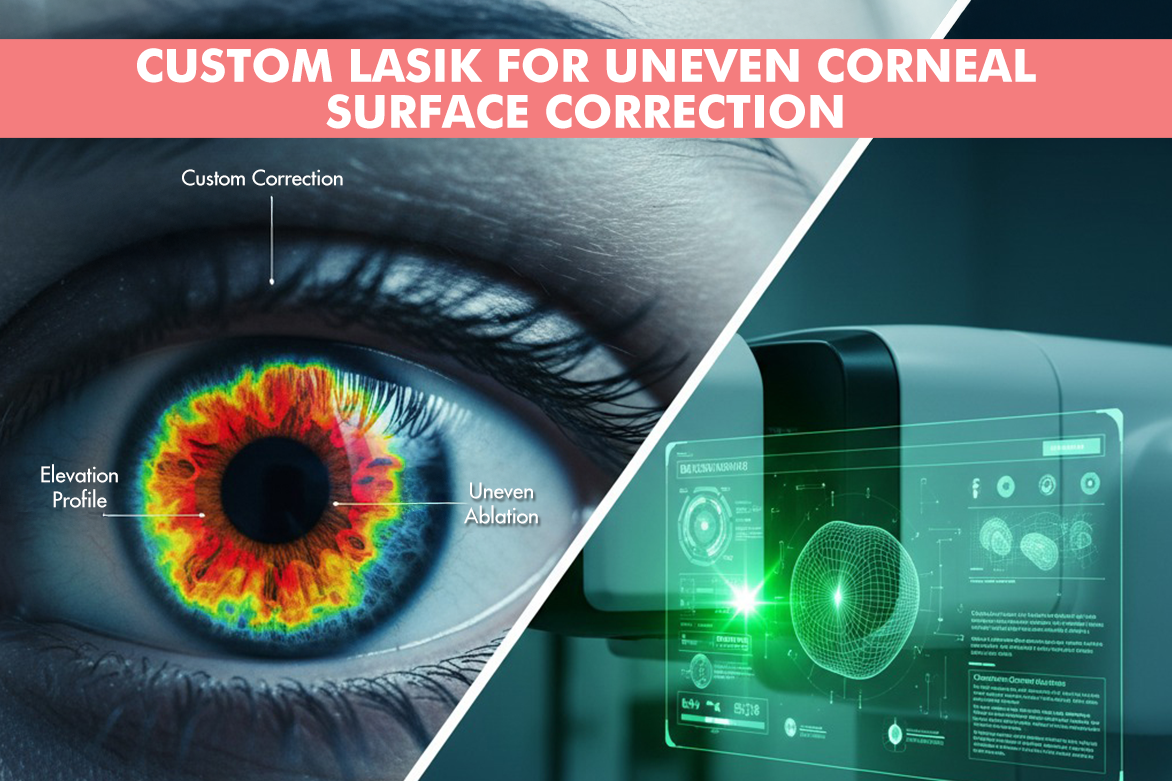
Custom LASIK starts well before the laser. Modern corneal topography creates a high-definition 3D map of every hill, dip, and valley on your eye’s surface, using sophisticated imaging like Pentacam, Orbscan, or Scheimpflug cameras.
Key Insights from Surface Mapping
- No two corneas are exactly the same—even between your own eyes!
- Detailed mapping helps your surgeon identify not just the obvious rough spots, but also microscopic higher-order aberrations, which can only be corrected by a tailored, not “one size fits all,” laser pattern.
- Topography-guided LASIK algorithms use these maps to program the laser for precise, point-by-point tissue reshaping.
Surface mapping means treatment targets YOUR unique anatomy, reducing the chances of decentering or unwanted changes in corneal shape. Results are sharper, especially at night and at the edges of your visual field.
Why Custom LASIK is a Game-Changer for Corneal Irregularities
Traditional LASIK is excellent for simple nearsightedness or astigmatism, but can fall short when the cornea is irregular. Custom LASIK—also known as Wavefront- or Topography-Guided LASIK—uses personalized surgical plans based on your own maps and vision needs.
- By targeting minute optical imperfections and specific trouble zones on the cornea, Custom LASIK can dramatically improve both daytime and night vision.
- It reduces the risks of post-surgery halos, “starbursts,” and poor contrast sensitivity that sometimes affect conventional laser patients, especially those with challenging corneas.
- For patients with keratoconus or prior surgical scars, when combined with corneal cross-linking, Custom LASIK can be part of an integrated rehab plan.
- Custom LASIK is especially transformative for people previously told they were “not candidates” for vision correction due to surface irregularities or prior complications.
Types of Custom LASIK Technologies
Here’s a quick guide to briefly understand different types of key Custom LASIK technologies:
- Wavefront-Guided LASIK: Uses aberrometry to map and correct “higher-order aberrations”—tiny optical flaws undetectable in a basic eye exam.
- Topography-Guided LASIK (Contoura, T-CAT): Uses external mapping to correct not only prescription errors but micro bumps and shape problems on the corneal surface.
- Contoura Vision: The latest FDA-approved, topography-guided system, known for phenomenal outcomes in cases with significant surface irregularity or post-surgical changes.
- Smart Surface (TransPRK/SmartSurf): A no-blade, no-touch version of surface ablation, enhanced by ultra-precise mapping and advanced 7D eye-tracking for flawless alignment (especially important with highly irregular or scarred corneas).
The Science Behind Custom LASIK: How It Works
Custom LASIK blends your eye’s unique measurements with state-of-the-art lasers running algorithms fine-tuned to your anatomy.
Step 1: Multiple advanced scans create a complete corneal and ocular map.
Step 2: AI-driven software analyzes the data, highlighting all imperfections and translating these into a personalized reshaping plan.
Step 3: During surgery, advanced lasers (often with 7D eye tracking) synchronize every laser pulse to your real-time micro-movements, ensuring absolute precision—even when your eye naturally tilts or trembles.
Benefits of Custom LASIK for Patients with Uneven Corneas
Custom LASIK enables transformative benefits for those with previously untreatable corneas:
- Sharper vision than glasses or standard LASIK, with higher resolution and contrast sensitivity.
- Fewer visual side effects, including reduced glare, halos, and ghosting, especially in dim light.
- Greater spectacle independence for reading, night driving, and digital work.
- Minimally invasive and swift: healing is fast, discomfort is mild, and most patients resume regular activities in days.
- Long-term stability: Personalized correction reduces the risk of regression or future vision changes.
Who Is a Candidate for Custom LASIK?
Custom LASIK is ideal for:
- Patients with stable vision prescriptions (typically unchanged for 1 year or more)
- Eyes with healthy corneal thickness (or mild thinning, if advanced mapping is available)
- Individuals with irregular astigmatism, keratoconus (after cross-linking), or prior surgical complications
- Those motivated for crisp, tailored vision across all lighting conditions
- Patients with realistic goals—your doctor will discuss what’s achievable for your specific needs
People with the following conditions are not fit for the Custom LASIK:
- Progressively thinning corneas (untreated keratoconus)
- Active eye infection or untreated inflammation
- Unstable vision, advanced dry eye, or insufficient corneal tissue
Preparing for Custom LASIK: What to Expect
Preparation is as important as the procedure itself.
- Comprehensive Eye Exam: Multiple digital maps, dilation, assessment of ocular health
- Contact Lens Holiday: You’ll be asked to stop wearing contacts for several days prior to scans (they can warp the cornea temporarily)
- Discuss Medications and Medical History: Some medications may temporarily affect corneal hydration or increase your surgical risk
- Day of Surgery: Bring a friend or family member—you’ll need a ride home. Eat light, wear no makeup, and follow your doctor’s fasting and hydration advice.
Recovery and Long-Term Results
- Expect some mild dryness or scratchiness for the first few days; lubrication drops are your friend.
- Vision usually stabilizes in about a week, with continual improvement for up to 1–3 months.
- Follow recommended follow-up schedules closely—tracking healing and results ensures the best outcome.
- Most patients experience high satisfaction, stable vision, and an expanded range of activities.
Conclusion
Custom LASIK offers a powerful, personalized solution for vision correction, especially for those with uneven or problematic corneal surfaces. Armed with advanced diagnostics, individualized treatments, and a commitment to excellence, eye care teams can help you reclaim sharp, reliable, and comfortable vision for years to come. If you’ve struggled with glasses and were once told you weren’t a candidate for LASIK, it’s time to explore what’s possible—your clearest vision may be just one custom procedure away.
FAQs
Can LASIK fix an irregular cornea?
Yes, custom LASIK, especially topography-guided or wavefront-guided, can treat many irregular corneas by targeting surface unevenness and higher-order aberrations.
What is the difference between standard and custom LASIK?
Standard LASIK corrects basic vision errors using a preset laser pattern; custom LASIK uses detailed maps of your eye for a tailored, more precise correction.
Is topography-guided LASIK better for uneven eyes?
Absolutely. It creates a treatment profile based on your unique corneal shape, making it especially effective for eyes with surface irregularities.
How safe is LASIK for corneal irregularities?
With modern mapping and advanced lasers, custom LASIK is considered safe for many irregular corneas in appropriately screened patients under expert care.
Are results permanent with custom LASIK?
Results are long-lasting, but natural aging or unrelated eye changes may still affect vision over time.
What if I was told I’m not eligible for LASIK before?
New mapping and laser technologies mean many patients once ineligible may now qualify. Get a fresh evaluation from a reputed centre like Planet Lasik, which has all the advanced customization options. However, advanced cases of corneal ectasia (deformity) should not opt for LASIK and remain ineligible.
Does surface-mapping LASIK reduce night glare?
Yes, by correcting microscopic irregularities, custom LASIK often reduces night glare, starbursts, and halos compared to standard techniques.
What’s the recovery time for custom LASIK?
Most people see well within a week, with full stabilization in 1–3 months, depending on individual healing and case complexity.
How do I know which LASIK type is right for me?
A thorough evaluation, including topography, wavefront analysis, and a conversation about your vision goals, will help your surgeon recommend the ideal option.