
Table of Content
- Understanding Multifocal LASIK: A 2025 Perspective
- Vision Changes After 40 – Understanding Presbyopia
- Multifocal LASIK vs Other Presbyopia Treatments
- Key Benefits of Multifocal LASIK for Today’s Patients
- Who Makes an Ideal Candidate for Multifocal LASIK?
- Pre-Surgery Considerations: What You Need to Know
- Post-Surgery Expectations and Care in 2025
- Potential Risks and Considerations Before Multifocal LASIK
- What to Expect During and After the Procedure
- The Future of Multifocal LASIK
- Conclusion
- FAQs
The world of vision correction is evolving faster than ever, and multifocal LASIK stands at the cutting edge of presbyopia solutions for adults in 2025. No longer does turning 40 mean inevitable reading glasses or juggling bifocals. As we welcome the latest advances in laser technology, understanding who is a perfect candidate for multifocal LASIK—and what this revolutionary procedure can do—has never mattered more.
In this comprehensive and engaging guide, we cut through the jargon, demystify the science, and provide the key details about Multifocal LASIK candidates, the best age for multifocal LASIK, and several other aspects to help you make an informed decision about your visual future.
Understanding Multifocal LASIK: A 2025 Perspective
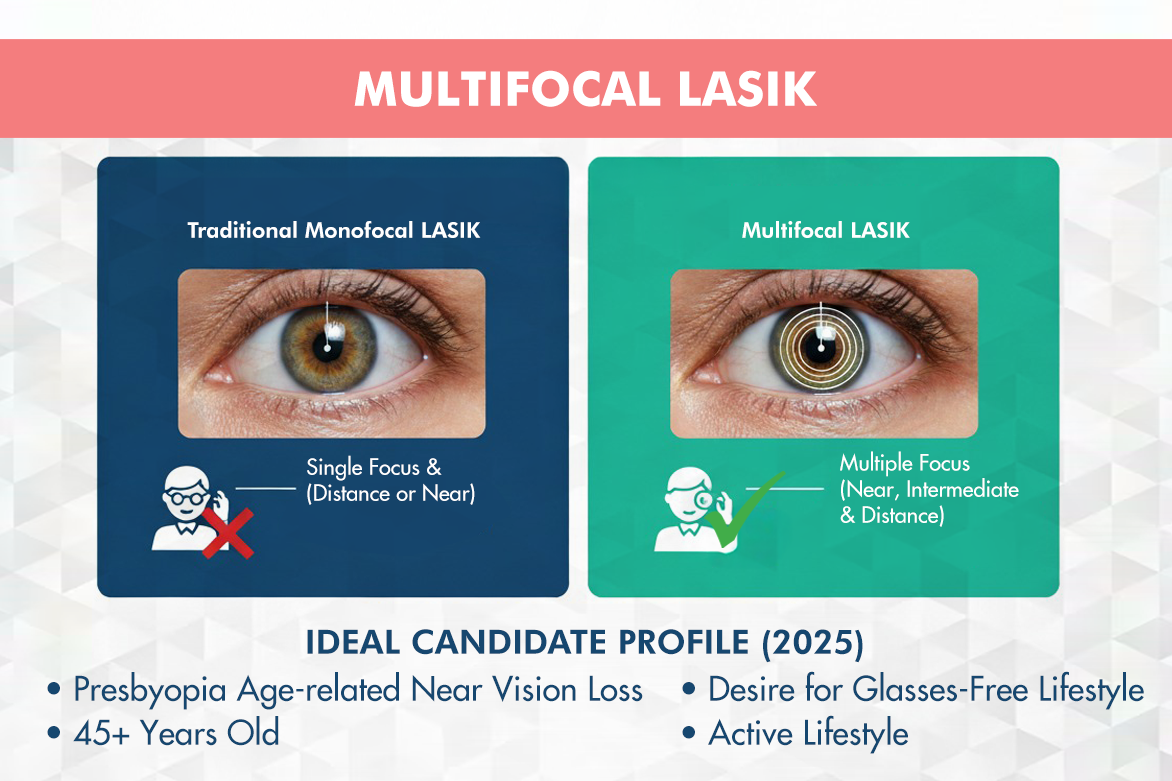
Since its introduction, multifocal LASIK has undergone a series of breakthroughs. What makes the procedure different in 2025? Advanced wavefront-guided lasers, ultra-precise ablation patterns, and improved ocular mapping make it possible to reshape the cornea with levels of accuracy unimaginable a decade ago. Multifocal LASIK creates multiple zones of focus on the cornea, allowing patients to see clearly at near, intermediate, and far distances—even in changing or dim light.
How it works:
- Sophisticated eye scanners map billions of data points on your cornea for the most personalized treatment possible.
- The laser reshaping process takes only a few minutes per eye but transforms daily life—goodbye to “reading glasses on, reading glasses off” moments!
- Over 90% of multifocal LASIK patients report independence from reading glasses within 6 months.
Vision Changes After 40 – Understanding Presbyopia
Presbyopia, often first noticed in one’s 40s, happens as the eye’s natural lens becomes less flexible, making up-close tasks like texting, reading, or checking a cheque frustratingly blurry. It’s a natural part of aging—a result of the lens stiffening and losing its zoom-like adjustment. Symptoms include:
- Needing to hold your phone or book further away
- Frequent headaches or eye strain, especially when reading fine print
- Switching between multiple pairs of glasses or struggling with multifocal or bifocal contacts
Did You Know?
Presbyopia affects virtually everyone eventually. Solutions in 2025 are more nuanced and far-reaching than ever before.
Multifocal LASIK vs Other Presbyopia Treatments
With various options available, it’s vital to compare multifocal LASIK to both traditional and modern alternatives:
| Solution | Pros | Cons |
| Reading glasses/bifocals | Simple, non-invasive, and cost-effective | Inconvenient, easy to lose, no intermediate range |
| Multifocal contact lenses | Broad focus, no glasses needed | Can cause dryness, discomfort, adaptation issues |
| Corneal inlays | Implant for reading vision | Surgery needed, not for all, possible risks |
| Monovision LASIK | One eye for near, one for far | Some patients dislike visual imbalance |
| Multifocal LASIK | Correction at all distances, seamless | Not everyone adapts equally, rare night halos |
| PresbyMax | Detailed diagnostics for a personalized treatment plan | Temporary dry eyes |
Key Takeaway: Multifocal LASIK offers a permanent, all-in-one solution, eliminating reliance on external aids while adapting easily to everyday life.
Key Benefits of Multifocal LASIK for Today’s Patients
Why is multifocal LASIK generating so much excitement?
- Total Freedom: Most patients never need to reach for glasses again for any activity—reading, computer work, night driving, or travel.
- Natural, Seamless Vision: The latest algorithms mimic the eye’s own layered focusing system for a “natural” visual feel.
- Fast, Low-Discomfort Recovery: With femto-lasers and corneal mapping, most enjoy minimal discomfort and return to daily routines swiftly.
- Customization: Tailored plans address individual pupil sizes, corneal shapes, and lifestyle needs, making results more consistent than older surgeries.
- Long-Term Durability: Less regression than other presbyopia treatments, with high satisfaction rates years post-surgery.
Who Makes an Ideal Candidate for Multifocal LASIK?
Candidates for multifocal LASIK have expanded thanks to new technology, but ideal patients are:
- Age 40–65, experiencing difficulty with near and/or intermediate vision
- Stable prescription for at least a year
- Healthy corneas, adequate corneal thickness, and no history of corneal or retinal disease
- Flexible, realistic expectations and commitment to post-op care
- Free from severe dry eye, uncontrolled diabetes, or certain autoimmune disorders
Additional Considerations:
- Patients with active, engaged lifestyles (e.g., outdoor professionals, frequent travelers, digital natives) often notice the biggest boost in convenience and productivity.
- Not suitable for those with advanced glaucoma, uncontrolled cataracts, or retinal issues.
Pre-Surgery Considerations: What You Need to Know
- Comprehensive corneal mapping using ultra-high-res scanners
- Health and medication history review—disclose allergies and all ongoing medications
- Discussion of goals and visual priorities: Are night driving and digital screen clarity important to you?
- Education session on potential side effects: halos, glare, mild dryness—all usually transient with modern techniques
- Opportunity to ask questions: Discuss risks, recovery, and enhancement policies
Post-Surgery Expectations and Care in 2025
Advancements in laser platforms and post-op protocols mean healing has never been easier:
- Mild itching or watery eyes for 24–48 hours
- Vision clarity improves steadily, with most patients back to office work or daily errands within a week
- Eye shielding at night and medicated drops promote swift healing and prevent infection
- Regular check-ups—remotely or in-clinic—ensure stability and rule out rare complications
What to Watch For:
- Nighttime halos or glare—usually a short-lived adaptation effect
- Dry eyes—improved with novel lubricating gels and in-office hydration therapies
- Immediately communicate with your surgeon if you notice sudden blurriness, pain, or redness
Who Should Avoid Multifocal LASIK?
Although many are eligible, some should consider alternatives or be especially cautious:
- Active corneal disease (e.g., keratoconus), unstable or severe dry eye
- Pregnant women or those with uncontrolled autoimmune conditions
- People unable to adhere to post-op care or with unrealistic expectations about results
- Individuals with highly irregular corneas, extremely high/unstable prescriptions
Patients who are unfit for multifocal LASIK can explore other solutions like premium multifocal IOLs, advanced contact lenses, or staged surgical plans can provide clarity and safety.
Potential Risks and Considerations Before Multifocal LASIK
Every surgery has inherent risks. For multifocal LASIK, these may include:
- Halos or glare at night, especially in the first few months
- Difficulty adapting to multiple focal points (rare; brain adapts for most)
- Dry eye symptoms (improving with new protocols)
- Over- or under-correction, sometimes needing enhancements
- Rarely, mild infection or corneal haze (well managed by post-op care)
- Choose a surgeon with high-volume experience in multifocal LASIK for the best complication management and post-op support.
What to Expect During and After the Procedure
Pre-op: Numbing drops, gentle eye cleaning, digital corneal mapping
Surgery: Procedure time is less than 20 minutes per eye; no pain, only minor pressure sensations
Aftercare: Rest for 1–2 hours post-op; expect mild blurring that improves steadily
The Future of Multifocal LASIK
AI-powered diagnostics, enhanced custom ablation patterns, and real-time tracking are making multifocal LASIK even more precise and user-friendly moving forward. Expect even faster recoveries and better results as the technology matures year by year.
Conclusion
Multifocal LASIK in 2025 offers a freedom from presbyopia and reading glasses that previous generations could only dream of. With today’s technology, proper patient selection, and comprehensive care, a clear, seamless vision is a reality for motivated adults across the world. If you’re tired of juggling specs or seeking a long-term solution for effortless vision, speak with your ophthalmologist about the life-changing potential of multifocal LASIK. Your journey to a younger, clear vision starts now.
FAQs
What is multifocal LASIK and how is it different from regular LASIK?
Multifocal LASIK reshapes the cornea to create multiple zones for near and distance vision, correcting presbyopia, while regular LASIK provides a single correction for either near or distance vision.
At what age can I consider multifocal LASIK?
Most candidates are age 40 or older with signs of presbyopia and a stable eye prescription.
Is multifocal LASIK permanent?
Yes, the changes are permanent, but normal age-related eye changes may still develop over time.
Does multifocal LASIK affect night vision?
Some patients notice halos or glare at night, especially in the first few months. These usually improve as your eyes adjust.
Can multifocal LASIK correct both reading and distance vision?
Yes, it is specifically designed to give you clear vision at both near and far distances.
How soon can I return to work after multifocal LASIK?
Most people return to work within 2–3 days, depending on their job and how their eyes feel.
What are the risks of multifocal LASIK?
Risks include glare, halos, dry eyes, temporary vision fluctuations, or rarely, infection.
Can presbyopia return after the surgery?
Multifocal LASIK treats presbyopia, but aging may cause further eye changes in the future.
How do I know if I’m a candidate for multifocal LASIK?
A detailed eye exam and consultation with an experienced LASIK surgeon will determine if you qualify.
Is multifocal LASIK better than monovision correction?
For many, multifocal LASIK provides more balanced, natural vision at all distances, but the best choice depends on your needs and lifestyle.