
Table of Contents
- The Evolution of LASIK: From Manual to Machine Learning
- How Predictive Algorithms Enhance Surgical Precision
- Role of AI Tools in Modern LASIK Surgery
- Patient Safety: Minimizing Risks with Predictive Analytics
- Personalized Treatment Plans: The Role of Data in LASIK
- Comparing AI-Enhanced LASIK to Traditional Methods
- What to Expect with Predictive LASIK
- Success Rates and Patient Outcomes
- Overcoming Limitations and Challenges
- Future Trends: What’s Next for Predictive Algorithms in LASIK?
- Conclusion
- FAQs
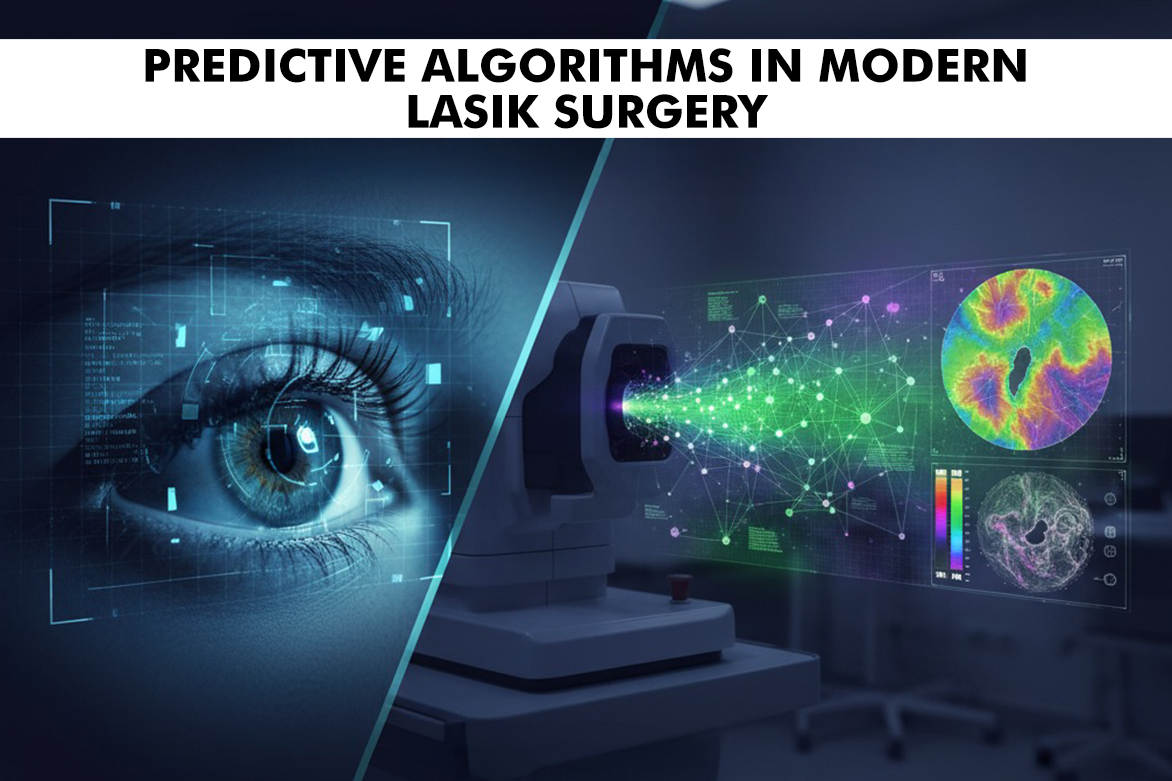
Imagine a world where every LASIK procedure is not only tailored to the unique characteristics of your eyes but also benefits from real-time data analysis and artificial intelligence that predicts not only the visual outcomes but also prevents complications before they occur. Welcome to the new era of eye care, where predictive algorithms are not just a technical buzzword but the driving force behind safer, sharper, and more reliable vision correction. In this blog, we’ll take a deep dive into how these technologies are revolutionizing LASIK surgery: from the consultation to the treatment and your visual recovery.
The Evolution of LASIK: From Manual to Machine Learning
LASIK was once a “one-size-fits-all” procedure, where skilled surgeons relied on their technique and a handful of measurements to deliver great results. Yet, the human eye is astonishingly complex; two identical prescriptions can have vastly different higher-order aberrations, corneal curvatures, or healing responses. Here, machine learning and predictive algorithms come into existence and empower surgeons with personalized, data-rich blueprints for each case.
Notable Milestones on LASIK’s Journey
- 1990s: Basic laser reshaping, standardized corrections
- 2000s: Introduction of wavefront-guided technology for more personalized vision
- Mid 2020s: AI-driven systems like Foresight analyze thousands of datapoints, elevating customization and precision beyond what manual planning allows
How Predictive Algorithms Enhance Surgical Precision
What makes predictive algorithms a game-changer in vision correction?
- Thorough Data Analysis: Each eye’s topography, prescription, tear film quality, and possible surgical outcomes are considered for laser programming.
- Anticipating Eye Response: Algorithms model how your particular cornea is likely to behave when treated, reducing surprises during surgery.
- Adaptive Planning: If intraoperative metrics shift (e.g., eye movement, corneal hydration), the laser can do real-time parameter adjustments, keeping the laser fire right on target.
- Reduced Operator Variability: Predictive analytics minimizes human variability and potential bias, which means outcomes are less dependent on a single surgeon’s style and more on universal best practices.
Role of AI Tools in Modern LASIK Surgery
AI now powers nearly every stage of advanced LASIK.
- Pre-operative Planning: AI tools analyze corneal scans, refraction, pupil size, and other key data to recommend the ideal ablation profile.
- Intra-operative Guidance: Smart tracking systems keep the laser perfectly centered even if you blink or your eye shifts slightly, maintaining utmost precision.
- Post-operative Monitoring: AI-assisted analytics monitor healing via digital imaging and patient-reported outcomes, flagging rare issues early for intervention.
Patient Safety: Minimizing Risks with Predictive Analytics
With advancement in technology, predictive algorithms can now identify:
- Post-surgery visual outcomes
- Candidates at higher risk for postoperative complications, such as infection, haze, or regression
- Those prone to dry eye or glare based on environmental, anatomical, and historical data
Practical Benefits:
- AI can offer surgeons next-step suggestions in case of intraoperative findings, lowering the odds of unplanned outcomes
- Reduced retreatments and revisions mean safer, happier patients
Personalized Treatment Plans: The Role of Data in LASIK
The days of “average” corrections are over. Here’s how personalized, data-driven LASIK stands out:
- Each patient’s laser profile is mapped not just to correct their prescription, but to optimize light scatter, aberration patterns, and even healing response.
- Algorithms consider your visual habits (think: night driving, prolonged screens), providing recommendations unique to your lifestyle.
- Outcomes are tracked by AI technology post-surgery.
Comparing AI-Enhanced LASIK to Traditional Methods
Traditional LASIK relied on the fixed skills and judgments of surgeons, and while many excelled, results could vary between clinics or even between eyes.
AI-driven LASIK surgery means:
- Predictive and excellent results
- Faster, safer recovery and lower complication rates
- Better outcomes for hard-to-treat cases—thin corneas, irregular astigmatism, large pupils
What to Expect with Predictive LASIK
The “LASIK journey” starts with a comprehensive digital assessment:
- Wavefront technology captures thousands of data points on your cornea, pupil size, tear film, and vision dynamics
- Results are instantly run through predictive algorithms to generate your personalized visual blueprint
- Once cleared and scheduled, your surgeon reviews the full plan and discusses potential risks and side effects
During the Procedure:
- Eye tracking and smart analytics guarantee steady, reproducible results
- Many patients report feeling reassured knowing that AI is double-checking each step
Post-Surgery:
State-of-the-art systems and expert doctors monitor your healing, offering proactive messages or reminders
Success Rates and Patient Outcomes
What does all this tech translate to in the real world?
- Over 96% of AI-enhanced LASIK patients achieve 20/20 vision or better
- Complication and enhancement rates continue to decrease year over year
- Patient satisfaction is higher, with more people describing their vision as “crisp,” “natural,” and “stable”—even years later
Case studies have shown that predictive technology especially benefits:
- Patients who are determined to undergo laser eye surgery for the first time and are looking for safety and assurance
- People with moderate irregular astigmatism or borderline maps
- Patients with active lifestyles—athletes, drivers, digital workers—who require all-day clarity
Overcoming Limitations and Challenges
While AI and predictive algorithms are transforming LASIK, there are a few practical limitations:
- Not all clinics offer the latest predictive planning tools. At Planet Lasik by Centre For Sight, you can get it. We have the two most advanced AI-driven LASIK surgeries available – Custom Eyes & Smart Surface.
- Some high-risk eye conditions (advanced keratoconus, severe dry eye, retinal pathologies) may still be unsuitable for LASIK, regardless of AI.
- AI-driven LASIK may involve slightly higher costs, but many patients find the value in safer, customized care.
Future Trends: What’s Next for Predictive Algorithms in LASIK?
LASIK surgery will continue to evolve and extend the boundaries of laser eye surgery with new technologies like:
- Real-time intraoperative adjustments (“smart lasers” that react on the fly)
- Integration with wearable health monitors and smart contact lenses
- Machine learning algorithms that continually “learn” from every surgery performed globally
These trends will bring even better safety, vision sharpness, and inclusivity for patients who were once told LASIK wasn’t an option.
Conclusion
The fusion of AI and predictive algorithms with modern LASIK has created a future where safer, smarter, and more personalized vision correction is accessible to more people than ever. From advanced diagnostics to performing the surgery with precision, these tools are rewriting the possibilities for laser vision correction. If you value precision, speed, and the best chance at seeing your world in high definition, AI-driven LASIK platforms are the best choice for you. Consult with our expert eye surgeon to determine if AI-driven LASIK could be your path to clear vision.
FAQs
- How do predictive algorithms work in LASIK?
Predictive algorithms work in LASIK by analyzing extensive patient data to create optimized surgical plans.
- Are AI tools used in all LASIK procedures?
While not all LASIK procedures use AI tools, their adoption is rapidly increasing due to their proven benefits.
- Do predictive technologies improve LASIK safety?
Predictive technologies indeed improve LASIK safety by identifying potential risks and allowing for real-time adjustments.
- Can AI help reduce the need for retreatment?
AI can help reduce the need for retreatment by providing more accurate initial results.
- Are results better with AI-enhanced LASIK platforms?
Generally, results are better with AI-enhanced LASIK platforms due to their increased precision and customization.
- Is LASIK using AI available in India?
AI-based LASIK, including technologies like Custom Eyes & Smart Surface, is available in India at Planet Lasik.
- How do I know if I’m eligible for AI-guided LASIK?
Eligibility for AI-guided LASIK depends on specific patient factors, which can be determined through a comprehensive eye examination.
- Is Contoura Vision an AI-based LASIK system?
No, it uses wavefront technology to map corneal irregularities and correct higher-order aberrations.
- What data is used in LASIK predictive systems?
LASIK predictive systems use data such as corneal measurements, refractive errors, and patient history.
- Will predictive LASIK cost more than traditional LASIK?
While predictive LASIK may cost more than traditional methods, the investment is often justified by the superior outcomes and enhanced safety.