
Vision correction has evolved significantly in today’s world, offering more advanced solutions for various needs. From reading glasses to multifocal lenses, people are increasingly looking for the most convenient and effective options to suit their lifestyles. One solution that has gained popularity is progressive lenses, which offer a more natural way to correct vision for those with presbyopia.
But what is progressive lens, and why has it become a go-to option for many? Understanding the pros and cons of progressive lenses can help clarify why they are a popular choice. This blog will guide you through everything you need about progressive lenses – from how they work to their benefits and whether they are the right choice for your vision needs.
Progressive Lenses Meaning
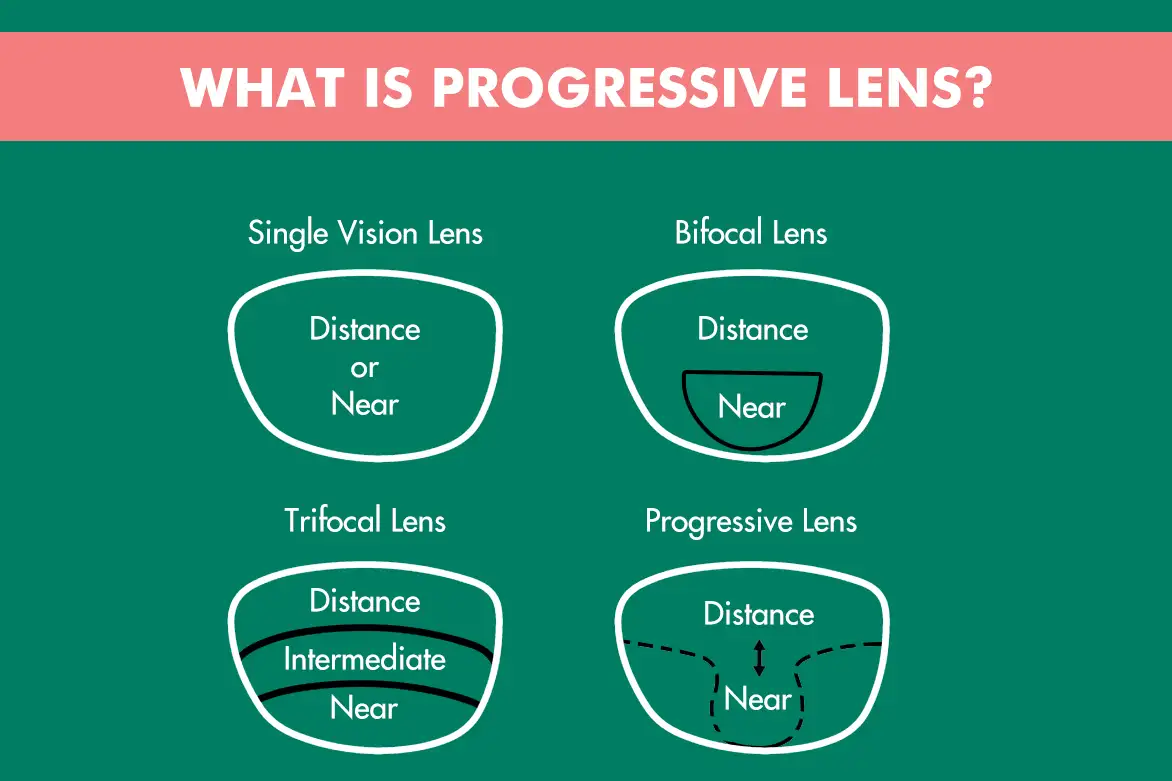
The word “progressive” refers to the way the lens power progresses, or changes gradually, from one zone to the next. In older bifocal lenses, you see a hard line across the glass where the reading prescription starts. Progressive lenses remove that line entirely. Your eyes move naturally down the lens, and the focus shifts with them.
You may also hear them called “progressive addition lenses” (PALs), “varifocal lenses,” or “no-line bifocals.” Progressive glasses meaning is the same across all these names: a single lens with a smooth gradient of prescription power from top to bottom, covering near, intermediate, and far distances in one pair.
How Progressive Glasses Work?
Progressive glasses, or progressive lenses, are specialized eyeglass lenses designed to correct vision across different distances, seamlessly transitioning from near to intermediate to far vision. So, they are very comfortable for those who need correction for presbyopia.
Traditional bifocal lenses allow for two distinct areas of vision correction – typically near and far- while trifocals add a middle or intermediate range. Progressive lenses, however, provide a gradual shift in focus without the abrupt changes seen in bifocals or trifocals. For those with presbyopia, this means a more natural visual experience, whether reading a book, working at a computer, or looking at a distant object.
This versatility is why many people, particularly those over the age of 40, are opting for progressive lenses instead of traditional single-vision or bifocal lenses.
Various types of progressive lenses are available in India, each offering unique benefits depending on the wearer’s needs. These lenses are designed with a gradual transition of focal powers. This allows for clear vision at multiple distances without any visible lines on the lenses. Each part of the progressive lens is customized to offer a specific range of vision correction. The upper part of the lens typically helps with distant vision, while the middle is designed for intermediate tasks, such as working on a computer. The lower part of the lens is reserved for near-vision tasks like reading.
Compared to bifocals or trifocals, progressive lenses offer a significant advantage. Since there are no visible lines, users don’t have to deal with the “image jump” or disjointed experience of switching between visual zones.
Types Of Progressive Lenses Available In India
Not all progressive lenses are the same. The design, manufacturing process, and degree of customisation vary across price tiers. Here are the main types available in India.
Standard (conventional) progressive lenses
These lenses use a standardized design rather than extensive individualized optimization, usually starting around Rs 3,000 to Rs 5,000 per pair in India. The viewing corridors are narrower, and peripheral distortion is higher compared to digital lenses.
These lenses use a standardised design rather than extensive individualised optimisation.
Digital (freeform) progressive lenses
Freeform lenses are manufactured using computer-controlled surfacing equipment, which allows the prescription to be placed with more precision across the lens. The result is a wider field of clear vision and less peripheral blur. Prices in India range from Rs 6,000 to Rs 15,000 depending on the brand and index. This is the most popular category for everyday use.
Office (occupational) progressive lenses
Also called computer progressives or near-variable-focus lenses. These are optimised for near and intermediate working distances, such as reading, desk work and computer use. The distance zone is reduced or removed entirely. If you spend four or more hours a day at a screen, these reduce neck strain because you do not have to tilt your head back as far to hit the intermediate zone. They are not suitable for driving.
Premium (personalised) progressive lenses
Premium lenses factor in your individual measurements: dominant eye, pupil position, frame tilt, and the distance between your face and the lens. Several international brands like Essilor Varilux, Zeiss, and Hoya offer these lenses in India. Prices start at Rs 15,000 and can go above Rs 25,000 per pair. Adaptation is faster with these lenses because the distortion zones are smaller.
Short-corridor progressive lenses
If you prefer smaller or fashionable frames, short-corridor lenses compress the three vision zones into a shorter vertical space. The trade-off is a narrower intermediate and reading area. These work best for people with low to moderate addition powers (up to +2.00 D).
Benefits of Progressive Lenses
Eliminates the Need for Multiple Glasses: One significant benefit of progressive lenses is their ability to consolidate your vision needs into a single pair, enhancing convenience. Hence, you no longer need separate glasses for reading and distance vision.
Natural Correction for Presbyopia: An advantage of progressive lenses is their ability to mimic natural vision more closely than traditional bifocals or trifocals, thanks to their design, which provides a smooth transition between focal points.
Improved Vision for Various Activities: Progressive lenses are ideal for driving, reading, and using computers, where they enhance visual comfort and reduce eye strain. The advantage of progressive lenses in these scenarios is their seamless adaptation to different visual ranges.
Limitations And What To Expect
Progressive lenses have peripheral distortion. The areas to the left and right of the central corridor, especially in the lower half of the lens, are slightly blurred. This is a physics constraint, not a defect. Every progressive lens has it; more expensive lenses reduce it but cannot eliminate it.
First-time wearers often notice a “swimming” sensation when they move their head quickly, or a slight curve in the floor when looking down. Most people adapt within 5 to 14 days of consistent wear. Consistent wear may help people become accustomed to the new visual experience, but “switching slows adaptation” is too definitive.
Higher prescription powers (especially additional powers above +2.50 D) produce wider distortion zones. For some prescriptions and wearers, a well-fitted freeform or personalised design may provide a wider usable visual field and greater comfort than a conventional design.
Are Progressive Lenses Right for You?
Now that you know what a progressive lens is, the next question to ask is, how do you determine if it suits you?
Progressive lenses could be an excellent choice if you have presbyopia and require vision correction for multiple eye powers.
One common question people have is, “Is a progressive lens good for the eyes?” Generally, progressive lenses benefit eyes by providing natural vision correction for multiple focal distances without needing multiple glasses. So, they save a lot of strain on the eyes and offer a natural experience.
However, it’s important to note that progressive lenses may require an adjustment period. Some users experience initial discomfort or difficulty finding the optimal focal point, but these issues typically resolve over time. Consulting with an optometrist can help determine if progressive lenses are the right fit for your specific needs.
How to Get Used to Wearing Progressive Lenses?
As with any new eyewear, there are some challenges when adapting to progressive lenses. Many first-time users report difficulty finding the “sweet spot” for each range of vision, which can lead to headaches or eye strain initially. The key is to be patient during this adjustment period. It can take a few days to a couple of weeks for your eyes and brain to fully adapt to the new lenses.
- Start by wearing progressive lenses for a few hours daily and gradually increase the time.
- Be mindful of how you move your head and eyes when shifting focus between different distances.
This practice will help you adjust to the smooth transition between focal points in the lenses. It’s also a good idea to visit your optometrist for adjustments. If you experience prolonged discomfort, your lenses may need slight modifications. Don’t hesitate to discuss any challenges with your optometrist, as they can offer personalized advice on fitting and adjustments.
Are you looking for an ophthalmologist near to you to discuss your vision needs?
Locate the nearest Planet Lasik facility!
Cost of Progressive Lenses In India
Progressive lens prices in India vary by type, brand, and lens index (thickness). Here is a rough range as of 2026:
|
Lens type |
Approx. price range |
Best for |
|
Standard (conventional) |
Rs 3,000 to Rs 5,000 |
Mild presbyopia, budget-conscious |
|
Digital (freeform) |
Rs 6,000 to Rs 15,000 |
Everyday use, screen + driving |
|
Office / occupational |
Rs 5,000 to Rs 12,000 |
Heavy screen users (4+ hours/day) |
|
Premium (personalised) |
Rs 15,000 to Rs 25,000+ |
High add power, fast adaptation |
These prices are for lenses only; frame costs are separate. Higher-index lenses (1.67 or 1.74), which are thinner and lighter, add Rs 2,000 to Rs 5,000 to the cost. Anti-reflective and blue-light coatings are usually included in the digital and premium tiers but may cost extra on standard lenses.
FAQs
What is progressive lens?
A progressive lens is a multifocal lens that gradually transitions between different focal points, offering clear vision at all distances (near, intermediate, and far) without visible lines. It’s ideal for correcting presbyopia and other vision changes.
Are progressive lenses good for eyes?
Yes, progressive lenses are beneficial as they offer a natural, seamless transition between vision ranges, reducing eye strain and improving visual comfort. They also eliminate the need for multiple pairs of glasses. They do not weaken your eyes or change your prescription over time.
Which is better, bifocal or progressive?
Progressive lenses are generally better than bifocals because they provide a smooth transition between vision zones without visible lines, making them more comfortable. Bifocals are simpler, cheaper, and require no adjustment period. If your day involves switching between reading, screens, and distance, progressive lenses are the better choice. If you do not use screens much, bifocals work fine.
What is the main drawback of progressive lenses?
The main drawback is the adjustment period. Some users may experience initial discomfort or difficulty finding the correct focal point, which usually resolves after a few days to weeks. If you experience prolonged discomfort, your lenses may need slight modifications.
What is the cost of progressive lenses in India?
Standard progressive lenses start at around Rs 3,000 per pair. Digital freeform lenses cost Rs 6,000 to Rs 15,000. Premium personalised lenses from brands like Essilor, Zeiss, or Hoya range from Rs 15,000 to Rs 25,000 or more. The final price depends on your lens index (thickness) and any coatings you add.
What is the age limit for progressive lenses?
There’s no strict age limit for progressive lenses, but they are most commonly used by individuals over 40 with presbyopia. They can also be used by younger people who have accommodative problems or who need both distance and near correction. Your optometrist will determine suitability based on your prescription, not your age alone.
What is the meaning of progressive glasses?
Progressive glasses meaning refers to eyeglasses fitted with lenses that have a gradual change in prescription power from top to bottom. The top corrects distance vision, the middle handles intermediate distances like screens, and the bottom is for reading. There are no visible lines between the zones, unlike bifocals.