
Table of Contents
- The Scope and Impact of Myopia Progression in Teens
- How Modern Laser Vision Correction Surgeries Work
- Laser Vision Correction in Adolescents: Safety and Suitability
- Can Laser Vision Correction Prevent Myopia Progression in Teens?
- Risks, Complications, and Long-Term Implications
- Best Practice Approaches: Alternatives for Myopia Control
- Empowering Families with Information and Support
- Conclusion
- FAQs
Myopia, or nearsightedness, has emerged as a significant eye health challenge among today’s teenagers. People often ask whether laser vision correction myopia progression can truly help or if other strategies are better suited to prevent myopia progression teens face during these crucial years. Across India and globally, the number of adolescents developing myopia is steadily climbing, a trend linked to modern lifestyle factors such as prolonged screen exposure, intensive educational demands, and reduced time spent outdoors. This growing epidemic not only impairs daily vision but also carries long-term implications for eye health if not managed effectively.
The Scope and Impact of Myopia Progression in Teens
Understanding the mechanism of myopia is essential. In myopia, the eye elongates excessively, causing incoming light to focus in front of the retina instead of directly on it. This anatomical issue blurs distant vision and often worsens during childhood. This makes the need for evidence-based interventions in myopia control in teenagers more urgent than ever. The risk factors are multifactorial:
- Genetic Predisposition: Family history of myopia can significantly increase the risk.
- Environmental Triggers: High-intensity near work (such as reading, studying, and digital device use) and limited exposure to natural daylight lead to increased myopia rates in youth.
- Lifestyle Habits: The decreasing trend in outdoor activities, often less than an hour per day for many teens, directly correlates with rising myopia prevalence and severity.
For Indian families, who often juggle academic aspirations and health concerns, early and effective intervention is critical to preserve quality of life and academic performance.
How Modern Laser Vision Correction Surgeries Work?
Advanced laser vision correction surgeries, including advanced procedures such as Custom Eyes, SILK, SMILE, Contoura Vision, and Smart SurfACE, utilize cutting-edge laser technology to reshape the cornea, the eye’s clear, front surface. By making extremely small, highly controlled adjustments measured in microns, these surgeries can shift the focal point of incoming light directly onto the retina, eliminating or reducing the need for corrective eyewear.
- Custom Eyes LASIK: Utilizes artificial intelligence-driven 3D corneal mapping, capturing more than 1,00,000 precise data points of the cornea to deliver individualized treatment.
- SILK/SMILE: A flapless procedure that utilizes an advanced femtosecond laser to create a small lenticule in the cornea, which is later extracted through a small incision (2-4mm), reshaping the cornea and achieving the desired visual outcomes.
- Contoura Vision: Employs topography-guided ablation to treat corneal irregularities with utmost accuracy, leading to clearer and more detailed vision quality.
- SmartSurfACE: As a flapless, touch-free approach, it is especially suitable for those with thinner corneas and for minimally invasive intervention.
These technologies allow for rapid recovery, improved night vision, and reduced chances of complications compared to older methods
Laser Vision Correction in Adolescents: Safety and Suitability
While the technological safety profile of modern laser procedures is excellent for eligible adults, clinicians exercise caution in recommending them for teenagers. Key considerations include:
Ocular Growth: Eyes typically continue to grow and change shape throughout adolescence, making vision correction procedures potentially unstable if performed too early.
Vision Stability Required: Most eye care experts agree that laser procedures should be delayed until there is documented stability in the teens’ refraction—generally, no significant increase in power for at least 12–24 months.
Health and Age Criteria: Teens with certain corneal diseases, autoimmune disorders, or those on medications affecting wound healing may not be suitable candidates.
Can Laser Vision Correction Prevent Myopia Progression in Teens?
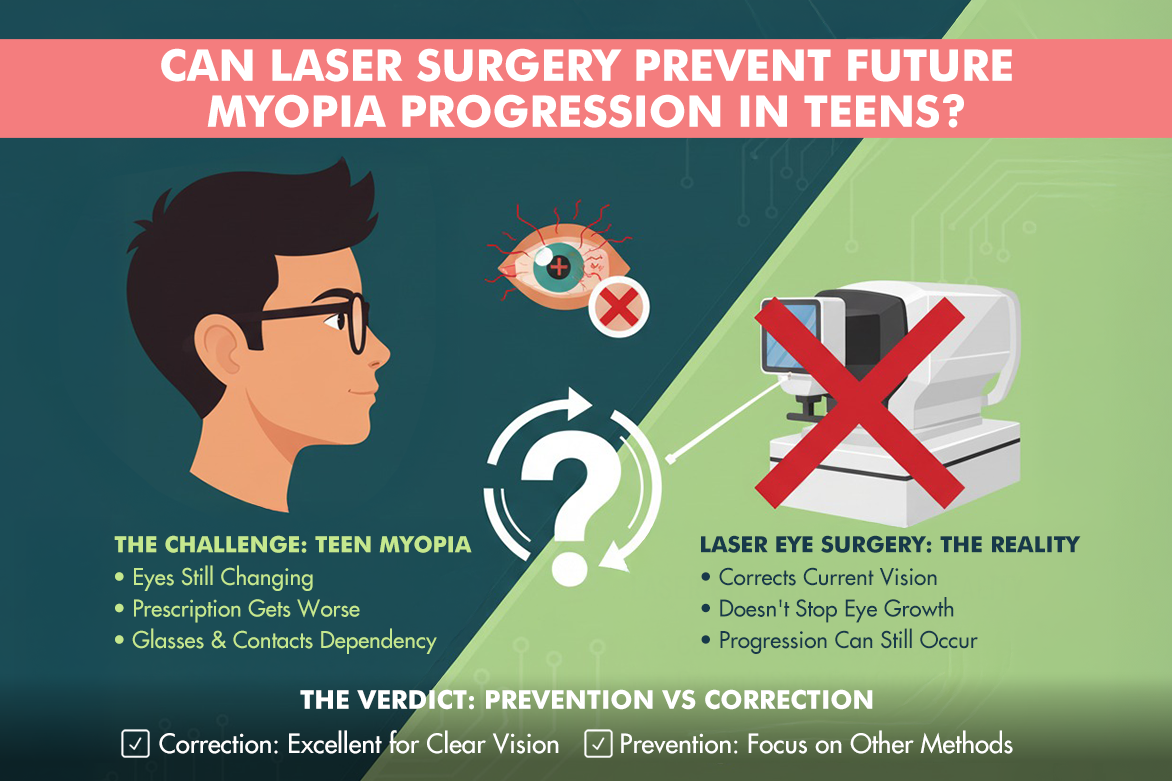
It’s crucial to understand the intended outcome of these procedures. While laser vision correction can dramatically improve uncorrected vision by reshaping the cornea, families often ask whether lens or laser for myopia prevention is the right approach. Current scientific consensus indicates that these surgeries do not target the root causes driving myopia progression, which occur deeper inside the eye, particularly in the elongation of the eyeball. Current clinical evidence supports the following:
Refractive Correction, Not Disease Modulation: Procedures like LASIK, Contoura Vision, and Smart SurfACE are designed to correct existing refractive errors (myopia, hyperopia, astigmatism), not to halt ongoing eye growth.
No Proven Effect on Axial Elongation: Longitudinal studies and clinical trials have not demonstrated a consistent benefit of laser vision correction in slowing or stopping the elongation of the eye that leads to worsening myopia.
Potential for Regression if Progression Continues: If a teen’s eyes are still growing, any correction achieved by surgery may be lost as myopia progresses further, necessitating additional interventions.
Risks, Complications, and Long-Term Implications
- Over- or Under-Correction: Eyeball growth after surgery may alter the refractive outcome. Even residual eye power can be there post-surgery.
- Transient or Chronic Dry Eye: More commonly seen in younger and female patients.
- Corneal Haze or Scarring: Particularly relevant in surface-based procedures or if the healing process deviates from expected norms.
- Need for Repeat Procedures: If myopia continues to progress, further correction might become necessary, exposing patients to additional procedure-related risks.
Best Practice Approaches: Alternatives for Myopia Control
| Intervention | How It Works | Clinical Effectiveness | Suitability for Teens |
| Atropine Eye Drops | Low-dose atropine modulates eye growth pathways | Strong, clinically validated | High; requires monitoring |
| Ortho-K Lenses | Overnight contact lenses reshape cornea | Moderately strong evidence | High; compliance dependent |
| Spectacle Lenses | Peripheral defocus designs slow progression | Increasing evidence | High; ideal for all ages |
| Increased Outdoor Time | Boosts dopamine, slows axial lengthening | Strong, easy to implement | Universal |
Lifestyle modifications, such as a minimum of two hours of outdoor activity daily and regular breaks during prolonged near work, represent simple, impact-driven changes for families.
Empowering Families with Information and Support
For parents and teenagers navigating the many options for myopia management, partnership with an experienced eye care provider is invaluable. Personalized counseling ensures that each patient receives a tailored plan—balancing clinical effectiveness, safety, and lifestyle considerations. At CFS, with our pan-India network and commitment to cutting-edge diagnostics, we provide holistic myopia care rooted in global best practices.
Conclusion
Laser vision correction has transformed the lives of millions by offering freedom from spectacles and contact lenses. However, while these procedures are highly effective in correcting existing myopia, the current clinical consensus is clear: they do not prevent ongoing myopia progression in teenagers. For long-term protection of adolescent vision, evidence-based strategies such as low-dose atropine, ortho-k lenses, and lifestyle modifications remain the interventions of choice. Families are encouraged to seek periodic eye health evaluations for teens.
FAQs
- At what age is laser eye surgery safe for myopia?
Laser eye surgery is generally considered safe for individuals over the age of 18, provided their vision has stabilized. LASIK is not typically recommended for younger teens due to the ongoing development of their eyes.
- Can LASIK stop the progression of myopia in teens?
While LASIK can correct existing vision issues, it does not stop myopia progression.
- What are safer alternatives to LASIK for teenage myopia?
Safer alternatives for managing myopia in teens include ortho-k lenses, atropine eye drops, and lifestyle changes.
- Is myopia control possible without surgery?
Myopia control is possible without surgery through various non-invasive methods.
- Why is myopia increasing in children and teens today?
The increase in myopia among children and teens is often attributed to increased screen time, reduced outdoor activities, and other environmental factors.